Showing posts with label Encyclopedia. Show all posts

Monday, 21 August 2017

Ganesh Chaturthi

What is Ganesh Chaturthi? Why is it celebrated?

We celebrate this 10-day-long festival every year. But how many of us know what Ganesh Chaturthi is and why it is celebrated?


What is Ganesh Chaturthi? Why is it celebrated?
Photo: Reuters
Ganesh Chaturthi is a ten-day Hindu festival celebrated to honour the elephant-headed God Ganesha's birthday. He is the younger son of Lord Shiva and Goddess Parvati.
Ganesha is known by 108 different names and is the Lord of arts and sciences and the deva of wisdom. He is honoured at the start of rituals and ceremonies as he's considered the God of beginnings. He's widely and dearly referred to as Ganapati or Vinayaka. 
There are two different versions about Ganesha's birth. One has it that Goddess Parvati created Ganesha out of dirt off her body while having a bath and set him to guard her door while she finishes her bath. Shiva who has gone out, returned at that time, but as Ganesha didn't know of him, stopped him from entering. An angry Shiva severed the head of Ganesha after a combat between the two. Parvati was enraged and Shiva promised Ganesha will live again. The devas who went in search of a head facing north of a dead person could manage only the head of an elephant. Shiva fixed the elephant's head on the child and brought him back to life.
The other legend has it that Ganesha was created by Shiva and Parvati on request of the Devas, to be a vighnakartaa (obstacle-creator) in the path of rakshasas (demonic beings), and a vighnahartaa (obstacle-averter) to help the Devas.
This year, September 17th marks the beginning of this festival which is also called as Vinayaka Chaturthi. Here are some quick facts about the festival:

The festival begins on Shukla Chaturthi which is the fourth day of the waxing moon period, and ends on the 14th day of the waxing moon period known as Anant Chaturdashi. 


Maharashtra is the state known for grand scale Ganesh Chaturthi celebrations.


During the festival, colourful pandals (temporary shrines) are setup and the Lord is worshiped for ten days. 


There are four main rituals during the festival - Pranapratishhtha - the process of infusing the deity into a murti or idol, Shhodashopachara - 16 forms of paying tribute to Ganesha, Uttarpuja - Puja after which the idol could be shifted after it's infusion, Ganpati Visarjan - immersion of the Idol in the river. 


Foodies wait for Modak, a sweet dish prepared using rice or flour stuffed with grated jaggery, coconuts and dry fruits. The plate containing the Modak is supposed to be filled with twenty-one pieces of the sweet.


The festival was celebrated as a public event since the time of Maratha King Shivaji, but a Sarvajanik (Public) Ganesh idol was installed first by Bhausaheb Laxman Javale. 


Lokmanya Tilak changed the festival from a private celebration to a grand public event "to bridge the gap between Brahmins and non-Brahmins and find an appropriate context in which to build a new grassroots unity between them".


Lord Ganesha is also worshiped in Thailand, Cambodia, Indonesia, Afghanistan, Nepal and China.

Monday, 14 August 2017

INDEPENDENCE DAY – 15 AUGUST 2017

                      INDEPENDENCE DAY – 15 AUGUST 2017


INDEPENDENCE DAY OF INDIA

Independence Day is an annual observance celebrated every year on 15th of August. India’s Independence Day is a day of great significance for the people of India. At this day India got freedom from the British rule after long years of slavery. It has been declared as the National and Gazetted Holiday all across the India in order to independently commemorate the independence of country from British Empire on 15th of August in 1947.


It was not so easy for the India to get freedom from the Britishers however; various great people and freedom fighters of India made it a truth. They had sacrificed their lives in attaining the freedom for their future generations without worrying about their comfort, rest and freedom. They planned and acted upon various Independence Movements including violent and nonviolent resistance to get complete freedom. However, later independence Pakistan was partitioned from India which was accompanied by violent riots. That horrible riot was the reason of mass casualties and dislocation of people (more than 15 million) from their homes.


At this day, all the national, states and local government’s offices, banks, post offices, markets, stores, businesses, organizations, etc become closed. However, public transport is totally unaffected. It is celebrated in the capital of India with big enthusiasm however it is also celebrated in all the schools, colleges and other educational institutions by the students and teachers including public community and society.


15 AUGUST 2017

Independence Day of India would be celebrated by the people all over the India on 15th of August 2017, at Tuesday. This year in 2017, India will celebrate its 71th Independence Day to pay tribute and remember all the freedom fighters who had contributed a lot and fought for the Independence of India.


The first Independence Day was celebrated in India on 15th of August in 1947.


What was Special on 70th India’s Independence Day 2016


As per the media report, there was a plan by the Indian prime minister, Narendra Modi, to launch a programme named as “70 Saal Azadi-Zara Yaad Karo Kurbani”, also called “AZADI70” (means, 70 years of independence-Do recall the sacrifices). The aim of this campaign was to make Indian people aware that country is first and individual is secondary as well as remember those supreme sacrifices made by the great freedom fighters of India during the freedom struggle.


There was also a plan to perform a week-long “Tiranga Yatra” in order to motivate people regarding nationalism and patriotism. It begun on August 15 on the occasion of India’s Independence Day by the members of parliament, state legislatures, celebrities, all BJP ministers and lawmakers carrying the Indian Tricolour Flag. It took place from Arunachal border (with China) to the border with Pakistan (in Rajasthan, Punjab and Jammu and Kashmir).


HISTORY OF INDEPENDENCE DAY OF INDIA


Indian subcontinent was outpost by some European traders during 17th century. It was again slaved by British East India Company because of his big military strength. They established their local kingdoms and effective forces all through the India during 18th century. A great independence revolution was started by the people of India against the British rule in 1857. That Indian Rebellion is called as Great Rebellion, the Revolt of 1857, the Indian Mutiny, the Uprising of 1857 and the Sepoy Mutiny. It was started against British East India Company’s army at Bengal Presidency on 10th of May in 1857. Through that Rebellion (Government of India Act 1858), Indian freedom fighters made British Crown realized to free the control over India.


The Revolt of 1857 was effective rebellion after which various civic society were emerged all across the India. One of them was the Indian National Congress Party which formed in the year 1885. The period of dissatisfaction and unhappiness has raised non-violent movements (non-cooperation and civil disobedience) all through the nation which was led by the Mohandas Karamchand Gandhi.


In the meeting of Indian National Congress in 1929 at Lahore, India was declared as Purna Swaraj. Earlier, 26th of January was declared as the Indian Independence Day between 1930 and 1947. Indian citizens were requested by the Indian National Congress to civil disobedience as well as follow the timely instructions issued until complete independence of India.


After World War II, in 1947 British government get ensured that it no longer could show its power on the India. Indian freedom fighter were continued fighting and then Britain decided to free India from the rule however Hindu Muslim violence took place after the independence of India (on August 15, 1947) which separated India and Pakistan. Muhammad Ali Jinnah became the first Governor General in Karachi Pakistan. However, Pandit Jawaharlal Nehru became the first prime minister of independent India. An official ceremony was held in the capital of country, Delhi where all the great leaders and freedom fighters (Abul Kalam Azad, B. R. Ambedkar, Master Tara Singh, etc) took part to celebrate freedom.


During violence of partition mass of people from both sides were died while people in other regions were celebrating Independence Day. The fifth meeting of the Constituent Assembly was held at 11 pm on 14th of August at Constitution Hall, New Delhi under the leadership of president, Rajendra Prasad where Jawaharlal Nehru proclaimed his speech.


In the midnight of 15 August 1947, India was proclaimed as independent country by the Pandit Jawaharlal Nehru where he gave his speech over “Tryst with destiny”. He said during his speech that “Long years ago we made a tryst with destiny, and now the time comes when we will redeem our pledge, not wholly or in full measure, but very substantially. At the stroke of the midnight hour, when the world sleeps, India will awake to life and freedom. A moment comes, which comes, but rarely in history, when we step out from the old to the new, when an age ends and when the soul of a nation, long suppressed, finds utterance. We end today a period of ill fortune, and India discovers herself again.” Speech on 15 August 1947 by Nehru


After that, all the Assembly members took pledge of being loyal in offering their services to the country. National flag was officially presented to the assembly by a group of Indian women. Finally India became an independent country officially, and Nehru and the viceroy, Lord Mountbatten, became the first prime minister and first governor general respectively. Mahatma Gandhi was not involved in the celebration. He stayed in the Calcutta and marked the Independence Day with his 24 hours fast in order to encourage the peace between Hindu and Muslim.


INDEPENDENCE DAY CELEBRATION

India’s Independence Day is celebrated all over the country as a National holiday of India. It is observed every year in every Indian states and union territories with great enthusiasm. President of India gives a speech every year in order to “Address to the Nation” on the evening of a day before the Independence Day. It is celebrated with big passion in the Capital of country on 15th of August where the prime minister of India hoists the Indian flag on the Red Fort, Delhi. After the flag hoisting, National Anthem song is sung and twenty-one gun shots are fired to salute and honour the Indian flag and solemn occasion.


The prime minister of India highlights over all the achievements of past year, important social issues and solutions, further development in the country, educational matters, etc during his speech on the Independence Day after paying tribute to the freedom fighter and leaders of the Indian independence movement who had sacrificed their lives. A grand march past takes place by the Indian Armed Forces and paramilitary forces. The celebration of independence day takes place in different states of diverse cultural traditions where Chief Ministers of individual states hoist the national flag flowed by various cultural activities by the participants.


Flag hoisting, National Anthem song play and parade ceremonies including other cultural programmes takes place in almost all the governmental and non-governmental institutions, educational institutions, some of the private institutions all through the country. In the schools and colleges the national flag is hoisted by the school or college Principal and parade and cultural events are carried out by the students. At this day, government offices, buildings, etc gets adorned with the electric lights, flowers and other decorative things. Different sizes of the national flags are used by the people to symbolize faithfulness and commitment to the country.


There is a big risk of terrorist attacks while celebrating the Independence Day especially in the major cities like Delhi, Mumbai and Jammu and Kashmir. That’s why no-fly zone is declared around the Red Fort to prevent aerial attacks. For more security reasons additional police forces are positioned all over the cities. Live broadcasting and webcasting is carried out by the media and government websites in order to provide live casting of the celebration of the event to the people all over the country.


It is also celebrated by the people with family members, friends and neighbors by going at dinner, picnic, park, garden, mall for shopping or seeing film, etc. Some people do flying or sing patriotic songs. At this day, kids of the home take a small flag in their hand and go outside by saying “jai Hind”, “Jai Jawan or Jai Kisan” and other popular saying.


Symbol and Significance of Independence Day in India


The kite flying sport in India symbolizes the Independence Day. The sky all over India becomes full of countless kites (flown from rooftops) of various sizes, shapes, styles, and shades. Some of them become tricolor symbolize India’s flag. Another symbol of independence day is the Red Fort of New Delhi where the first Indian Prime Minister, Jawahar Lal Nehru, unfurled the Indian flag on 15th of August in 1947.


Independence day is celebrated to commemorate the freedom of India from the British rule in 1947. 15th of August is the day of re-birth of the India. It is the day when Britishers left India and handed over the country to its leaders. It is the most significant day in the history of India and celebrated every year with great enthusiasm by the Indian people.

Friday, 11 August 2017

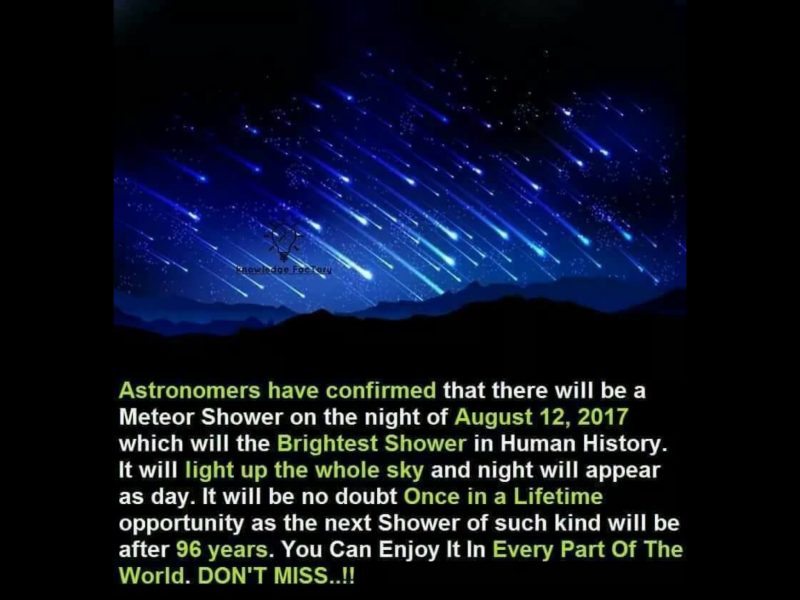
Best Perseid shower in 96 years?


Sorry, but THIS IS NOT TRUE.
Best Perseid shower in 96 years? Nah. We started seeing the meme above in late July on Facebook. Since then, many have asked us about it. Is it true? Will August 12, 2017 bring a spectacular meteor shower?
No. It’s not true. Let’s ignore the fact that “brightest” is not a word you’d typically hear astronomers apply to a meteor shower as a whole. A meteor shower is made of lots of separate meteors, after all, some bright and some faint. And let’s also ignore the fact that “light up the whole sky” is ridiculous for any meteor shower. As for “night will appear as day” … well, you get the idea. To an astronomer’s ear, it all sounds silly.
We’re not sure where the meme above originally got its (completely erroneous) information. It definitely didn’t come from astronomers, who tend to be precise and even cautious about making predictions of any kind. Maybe it stemmed from the predictions for a Perseid outburst in 2016. More about that at the bottom of this post.
At any rate, there are no predictions for a spectacular Perseid meteor shower in 2017. Those sorts of predictions typically stem from computer models, which sometimes suggest that, during this or that meteor shower, Earth will encounter a particularly rich stream of particles in space. Meteor showers are caused by debris left behind in the orbits of comets. Very rich showers occur when we encounter especially rich streams of this icy cometary debris.
In 2016, yes, there was such a prediction, and we heard later that the Perseids had slightly higher rates at their peak last year than normal. Meteor expert Bill Cooke of NASA wrote on August 3, 2017 that the Perseids never reach what are known as “meteor storm” levels (thousands of meteors per hour). He wrote:
At best, they outburst from a normal rate between 80-100 meteors per hour to a few hundred per hour. The best Perseid performance of which we are aware occurred back in 1993, when the peak Perseid rate topped 300 meteors per hour. Last year also saw an outburst of just over 200 meteors per hour.
In 2017, with no predictions for an outburst and with a bright moon in the way, the Perseids are not at all likely to produce a “once in a lifetime” meteor shower. In fact, they’re likely to be less spectacular than last year.
Sorry, y’all!
Early Perseid meteor caught on the morning of July 25, 2016 by Ken Christison.  Start watching for these meteors!  Thank you, Ken.
View larger and notice the colors. | Early Perseid meteor caught on the morning of July 25, 2016 by Ken Christison.
When and how should I watch the Perseid meteor shower in 2017? The Perseid meteor shower is known to rise to a peak gradually, over several weeks, and then fall off rapidly in the days following the shower. In 2017, we’re recommending that you start your meteor-watching in late July, when the moon is out of the way. Another shower – the the Delta Aquarid meteor shower – will be peaking around late July. The Delta Aquarids and Perseids overlap. They’ll ramble along steadily, with the Perseids growing in numbers, through early August. You’ll see the Perseids and Delta Aquarids together.
Considering the Perseids by themselves, the peak mornings will probably be during the predawn hours on August 12 and 13. The morning of August 11 might be worth watching as well. But, remember, by then, the moon will be in the way.
Here’s how to watch in bright moonlight. Sit within a moon shadow – the shadow of a building or row of trees – and otherwise enjoy an open view of sky.
Don’t rule out early evenings, either. As a general rule, the Perseid meteors tend to be few and far between at nightfall and early evening. Yet, if fortune smiles upon you, you could catch an earthgrazer – a looooong, slow, colorful meteor traveling horizontally across the evening sky. Earthgrazer meteors are rare but memorable. Perseid earthgrazers can only appear at early to mid-evening, when the radiant point of the shower is close to the horizon.
Perseid numbers typically reach 50 or more meteors per hour around the peak. In a typical year, although the meteor numbers increase after midnight, the Perseid meteors still start to fly at mid-to-late evening from northerly latitudes. South of the equator, the Perseids start to streak the sky around midnight.
Last year, in 2016, there was an outburst of Perseids, with the rate doubling for some observers on Earth. We don’t know of any outburst for 2017 – but you really never know for sure unless you watch!
General rules for Perseid-watching. No special equipment, or knowledge of the constellations, needed.
Find a dark, open sky to enjoy the show. An open sky is essential because these meteors fly across the sky in many different directions and in front of numerous constellations.
Give yourself at least an hour of observing time, for these meteors in meteor showers come in spurts and are interspersed with lulls. Remember, your eyes can take as long as 20 minutes to adapt to the darkness of night. So don’t rush the process.
Know that the meteors all come from a single point in the sky. If you trace the paths of the Perseid meteors backwards, you’d find they all come from a point in front of the constellation Perseus. Don’t worry about which stars are Perseus. Just enjoying knowing and observing that they all come from one place on the sky’s dome. See meteors coming from two different directions? Some of the meteors you see might be Delta Aquarids, not Perseids.
Enjoy the comfort of a reclining lawn chair. Bring along some other things you might enjoy also, like a thermos filled with a hot drink.
Remember … all good things come to those who wait. Meteors are part of nature. There’s no way to predict exactly how many you’ll see on any given night. Find a good spot, watch, wait.
What’s the source of the Perseid meteor shower? Every year, from around July 17 to August 24, our planet Earth crosses the orbital path of Comet Swift-Tuttle, the parent of the Perseid meteor shower. Debris from this comet litters the comet’s orbit, but we don’t really get into the thick of the comet rubble until after the first week of August. The bits and pieces from Comet Swift-Tuttle slam into the Earth’s upper atmosphere at some 130,000 miles (210,000 km) per hour, lighting up the nighttime with fast-moving Perseid meteors.
If our planet happens to pass through an unusually dense clump of meteoroids – comet rubble – we’ll see an elevated number of meteors. We can always hope!
Comet Swift-Tuttle has a very eccentric – oblong – orbit that takes this comet outside the orbit of Pluto when farthest from the sun, and inside the Earth’s orbit when closest to the sun. It orbits the sun in a period of about 133 years. Every time this comet passes through the inner solar system, the sun warms and softens up the ices in the comet, causing it to release fresh comet material into its orbital stream.
Comet Swift-Tuttle last reached perihelion – closest point to the sun – in December 1992 and will do so next in July 2126.
The radiant point for the Perseid meteor shower is in the constellation Perseus.  But you don't have to find a shower's radiant point to see meteors.  Instead, the meteors will be flying in all parts of the sky.
The radiant point for the Perseid meteor shower is in the constellation Perseus. But you don’t have to find a shower’s radiant point to see meteors. Instead, the meteors will be flying in all parts of the sky.
What is the radiant point for the Perseid meteor shower? If you trace all the Perseid meteors backward, they all seem to come from the constellation Perseus, near the famous Double Cluster. Hence, the meteor shower is named in the honor of the constellation Perseus the Hero.
However, this is a chance alignment of the meteor shower radiant with the constellation Perseus. The stars in Perseus are light-years distant while these meteors burn up about 100 kilometers (60 miles) above the Earth’s surface. If any meteor survives its fiery plunge to hit the ground intact, the remaining portion is called a meteorite. Few – if any – meteors in meteor showers become meteorites, however, because of the flimsy nature of comet debris. Most meteorites are the remains of asteroids.
In ancient Greek star lore, Perseus is the son of the god Zeus and the mortal Danae. It is said that the Perseid shower commemorates the time when Zeus visited Danae, the mother of Perseus, in a shower of gold.
Predicted Zenithal Hourly Rate (ZHR) for Perseids in 2016. The ZHR is the rate of the shower at its peak, when the radiant point is overhead (before dawn from all parts of Earth). Chart via Bill Cooke of NASA’s Meteoroid Environment Office. Indeed, the predicted outburst of Perseids in 2016 came to pass.
In 2016, there was a minor outburst of Perseid meteors Prior to the 2016 Perseid meteor shower, Bill Cooke, head of NASA’s Meteoroid Environment Office, began saying to expect a Perseid meteor outburst in 2016. He told us:
Every time Swift-Tuttle goes around the sun, it deposits a trail of particles which we call a meteor stream. Over time, the gravitational influence of Jupiter and other giant planets (but mainly Jupiter) changes the particle orbits, and as a result, their close approach distances to Earth will vary.
If the change for a given stream is towards Earth’s orbit, we may see greater than normal activity when our planet passes the trail’s nodal crossing.
IN 2016, Jupiter’s influence has moved the 1079, 1479, and 1862 [meteor] streams closer to Earth, so all forecasters were projecting a Perseid outburst with double double normal rates on the night of August 11-12 [evening of August 11, morning of August 12], 2016.
The peak rates were expected to last about half a day. Predictions varied for the actual time of the peak rates. And we did hear reports of increased Perseid rates in 2016. For example, the Sociedad de Astronomía del Caribe (Astronomical Society of the Caribbean) reported a Perseid outburst seen from La Pitahaya, Cabo Rojo, Puerto Rico on the morning of August 12, 2016.
We saw 506 Perseid meteors in a period of 4.75 hours. But we did see an outburst from 3:40 am to 4:00 am local time. During that short period, we counted 7.5 (7 to 8) meteors per minute, which means we saw 150 meteors in just 20 minutes!
One of the Perseids seen was unforgettable, says EarthSky contributor Eddie Irizarry of the Sociedad de Astronomía del Caribe:
… after the fast meteor streaked the skies, it left a bright, light blue colored smoke trail that lasted about 45 seconds as seen with the naked eye! The dissipating trail was observed for an additional 60 seconds using binoculars. That was a big one!

Thursday, 3 August 2017

What is Bitcoin?

Bitcoin is a new currency that was created in 2009 by an unknown person using the alias Satoshi Nakamoto. Transactions are made with no middle men – meaning, no banks! There are no transaction fees and no need to give your real name. More merchants are beginning to accept them: You can buy webhosting services, pizza or even manicures.

Why Bitcoins?

Bitcoins can be used to buy merchandise anonymously. In addition, international payments are easy and cheap because bitcoins are not tied to any country or subject to regulation. Small businesses may like them because there are no credit card fees. Some people just buy bitcoins as an investment, hoping that they’ll go up in value.

Acquiring Bitcoins

Buy on an Exchange
Several marketplaces called “bitcoin exchanges” allow people to buy or sell bitcoins using different currencies. Mt. Gox is the largest bitcoin exchange.
Transfers
People can send bitcoins to each other using mobile apps or their computers. It’s similar to sending cash digitally.
Mining
People compete to “mine” bitcoins using computers to solve complex math puzzles. This is how bitcoins are created. Currently, a winner is rewarded with 25 bitcoins roughly every 10 minutes.

Owning Bitcoins

Bitcoins are stored in a “digital wallet,” which exists either in the cloud or on a user’s computer. The wallet is a kind of virtual bank account that allows users to send or receive bitcoins, pay for goods or save their money. Unlike bank accounts, bitcoin wallets are not insured by the FDIC.
Wallet in cloud: Servers have been hacked. Companies have fled with clients’ Bitcoins.
Wallet on computer: You can accidentally delete them. Viruses could destroy them.

Anonymity

Though each bitcoin transaction is recorded in a public log, names of buyers and sellers are never revealed – only their wallet IDs. While that keeps bitcoin users’ transactions private, it also lets them buy or sell anything without easily tracing it back to them. That’s why it has become the currency of choice for people online buying drugs or other illicit activities.

Future in question

No one knows what will become of bitcoin. It is mostly unregulated, but that could change. Governments are concerned about taxation and their lack of control over the currency.

All about bitcoins


Bitcoin is the beginning of something great: a currency without a government, something necessary and imperative.”

Nassim Taleb, author of The Black Swan

How do people use bitcoins?

It is an electronic or digital currency that works on a peer-to-peer basis. This means that it is decentralised and has no central authority controlling it. Like currency notes, it can be sent from one person to another, but without a central bank or the government attempting to track it. The system depends on cryptography to control the creation of the currency. While no one authority controls the generation of the coins or tracks them, the system itself is designed in such a way that the network maintains a foolproof system of the record of every transaction as well as tracking issuance of the currency.

The beauty of this cryptocurrency is that if you receive a bitcoin from another, you can be as sure of the payment as you would on receiving physical currency notes, with the same anonymity ascribed to it. No one need know if your neighbour spent 2 bitcoins this morning to buy gold, but the transaction is recorded for posterity.

This anonymity is lacking in other forms of digital payment such as online banking or e-wallets.

Who can you send bitcoins to?

You can send bitcoins digitally to anyone who has a bitcoin address anywhere in the globe. One person could have multiple addresses for different purposes – personal, business and the like.

Receivers can get to spend them within minutes of receiving the coins. Once given away, like currency, there is no getting them back, unless the receiver decides to give them to you. A bitcoin is not printed currency but is a non-repudiable record of every transaction that it has been through. All this is part of a huge ledger called the blockchain.

Where do you get bitcoins?

Bitcoins are available in bitcoin exchanges. You could also purchase bitcoins from other users. A bitcoin exchange traded fund could be another source in the near future. You can become a bitcoin miner by investing in software and hardware. More the power of the hardware that helps with encryption technology, higher the probability of your earning bitcoins.

Unocoin is a Bengaluru-based company that allows users to buy, sell, store or use bitcoins. While bitcoin usage is certainly not mainstream, there are said to be more than 500 merchants who accept bitcoins for payment in India.

How is a new bitcoin generated?

A bitcoin is generated when an entity, i.e. a person or a business, uses software power to solve a mathematical puzzle that makes the blockchain more secure. The difficulty level of solving the problem is high enough to ensure that it takes time to do it.

Beware of tall promises

Even if you become a bitcoin miner, there is no guarantee that you would be able to mine a certain number of bitcoins. Any scheme related to bitcoins promising a fixed return is likely a tall promise best avoided.

Can you own 50 million bitcoins in, say, 2 years from now?

Unlike currency notes that can be printed by a central bank for an unlimited value, there are only so many bitcoins that can be produced. The blockchain system is designed such that at its maximum only 21 million bitcoins can be produced and in circulation. The number cannot exceed this cap. As of February, about 15.2 million bitcoins have been mined (or produced). That is about 75% of the total cap already in circulation.

Current estimates are that the last bitcoin that will ever be mined will come into existence in 2040.

What is the value of one bitcoin today?


One bitcoin is worth roughly about $1,200 now. An early investor in Snapchat has been quoted on the Web as saying that by 2030, the value could be as high as $500,000. One of the reasons that could prompt you to buy a bitcoin today is not so much to use it for payment online but as an investment.

Urban legend has it that someone who was doing a thesis on cryptocurrency bought 5,000 bitcoins for $27 in 2009. Do the math for the value today!

And unlike traditional currency that is inflationary in nature, the bitcoin is a deflationary currency. In other words, if there are only so many bitcoins in use, and the demand for those rises, the value of a bitcoin would, logically, rise.

How does the payment system work?

When you send a bitcoin to a receiver, the transaction is included in the blockchain and broadcast to the network. The blockchain ensures that the same bitcoin is not spent twice by the same user. A computer network validates the transaction using algorithms so that the transaction becomes unalterable. Once validated, the transaction is added to others to create a block of data for the ledger.